All posts

Okładka: AI Agents in Industry 4.0: From Automation to Autonomy

AI Agents in Industry 4.0: From Automation to Autonomy

Agentic AI is redefining the trajectory of Industry 4.0. Traditional systems have largely been reactive—analyzing data and supporting human decision-making. Today, a new paradigm is emerging: autonomous agents that independently make decisions, optimize processes, and adapt to changes in real time. In modern smart factories, these systems integrate with MES, IIoT, and ERP platforms to create self-optimizing environments. Machines no longer wait for instructions—they identify issues, anticipate disruptions, and act before production is affected.

Okładka: Data as the Foundation of Industry 4.0

Data as the Foundation of Industry 4.0

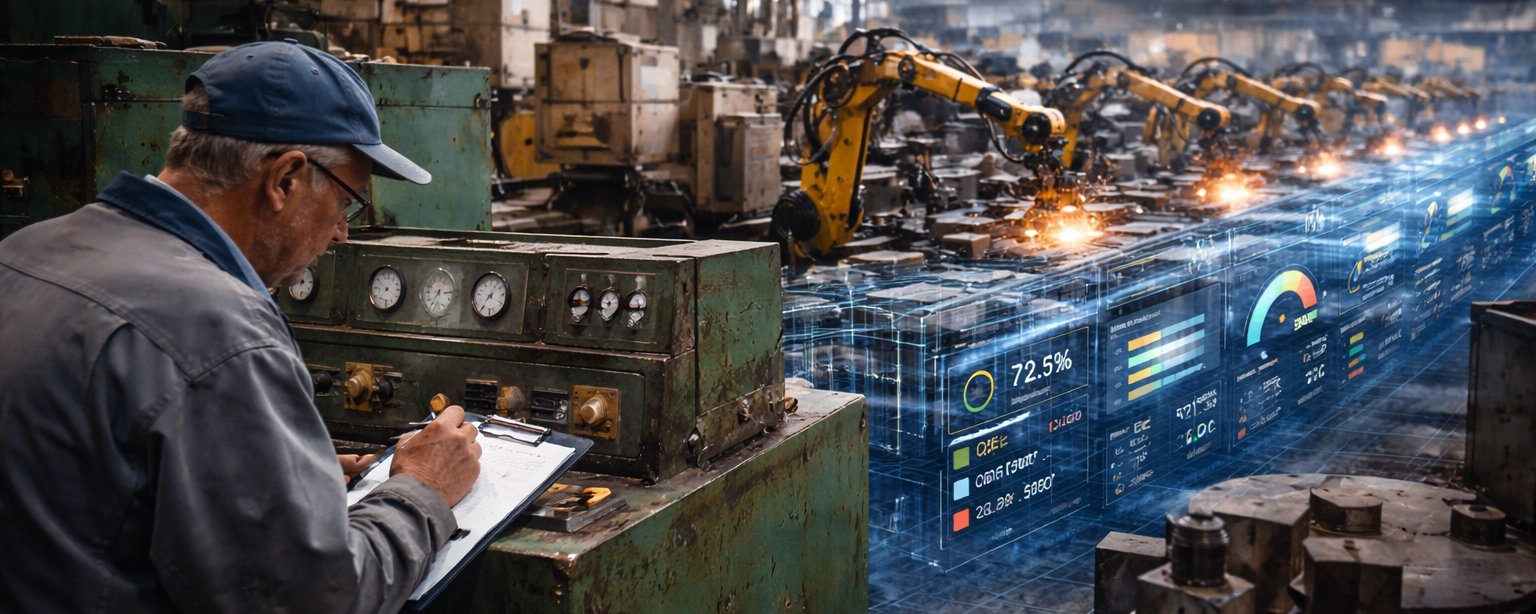
The concept of Industry 4.0 is based on continuous monitoring of production processes and decision-making driven by real-time data. Without reliable information, it is impossible to implement predictive maintenance, energy optimization, automated planning, or meaningful OEE analysis. If data is delayed, incomplete, or inconsistent, digitalization becomes only superficial. IT systems may be in place, but they do not deliver real business value. That is why it is critical to build an architecture in which data is collected automatically, consistently, and centrally.

Okładka: Pilot MES Implementation – How to Start and Why a Phased Approach Works Best

Pilot MES Implementation – How to Start and Why a Phased Approach Works Best

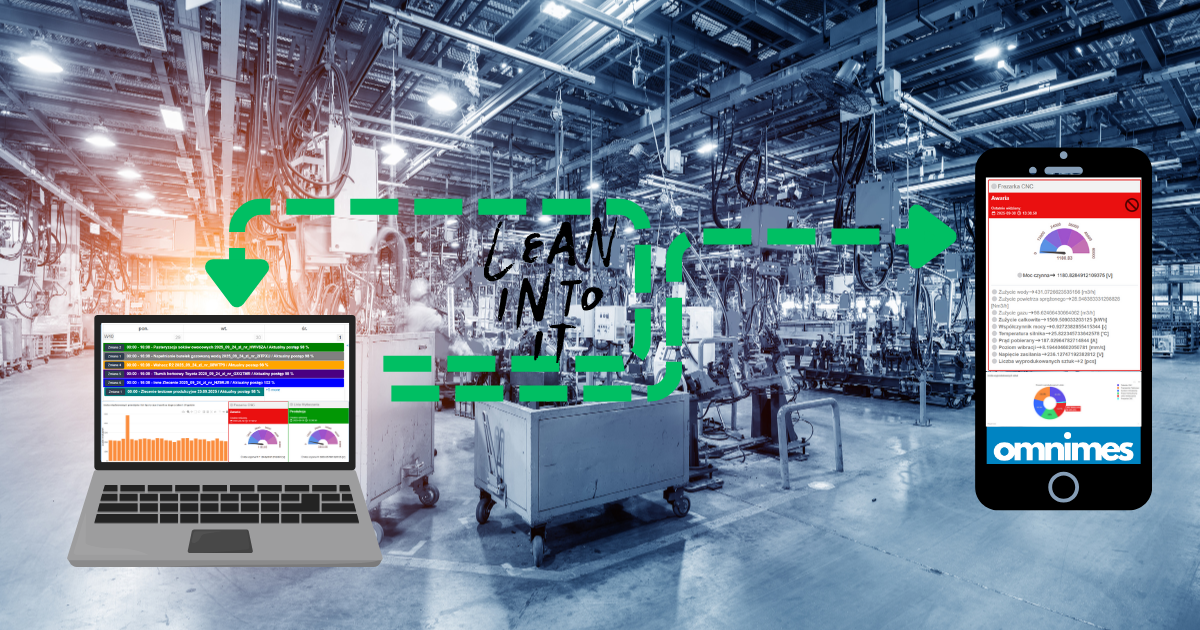
Implementing a Manufacturing Execution System (MES) rarely begins with a full-scale rollout across the entire production environment. In practice, the most effective approach is incremental—starting with a pilot implementation on a selected production line or area. This allows companies to validate the system in real operating conditions, collect data, and fine-tune the configuration before scaling across the entire machine park. More and more organizations choose a pilot not only for technical reasons but also for organizational ones. MES impacts the daily work of operators, production managers, maintenance teams, and planners. Therefore, implementation should be a controlled process rather than a one-time deployment.

Okładka: 2026: The Year Agentic AI Transforms Industrial Manufacturing

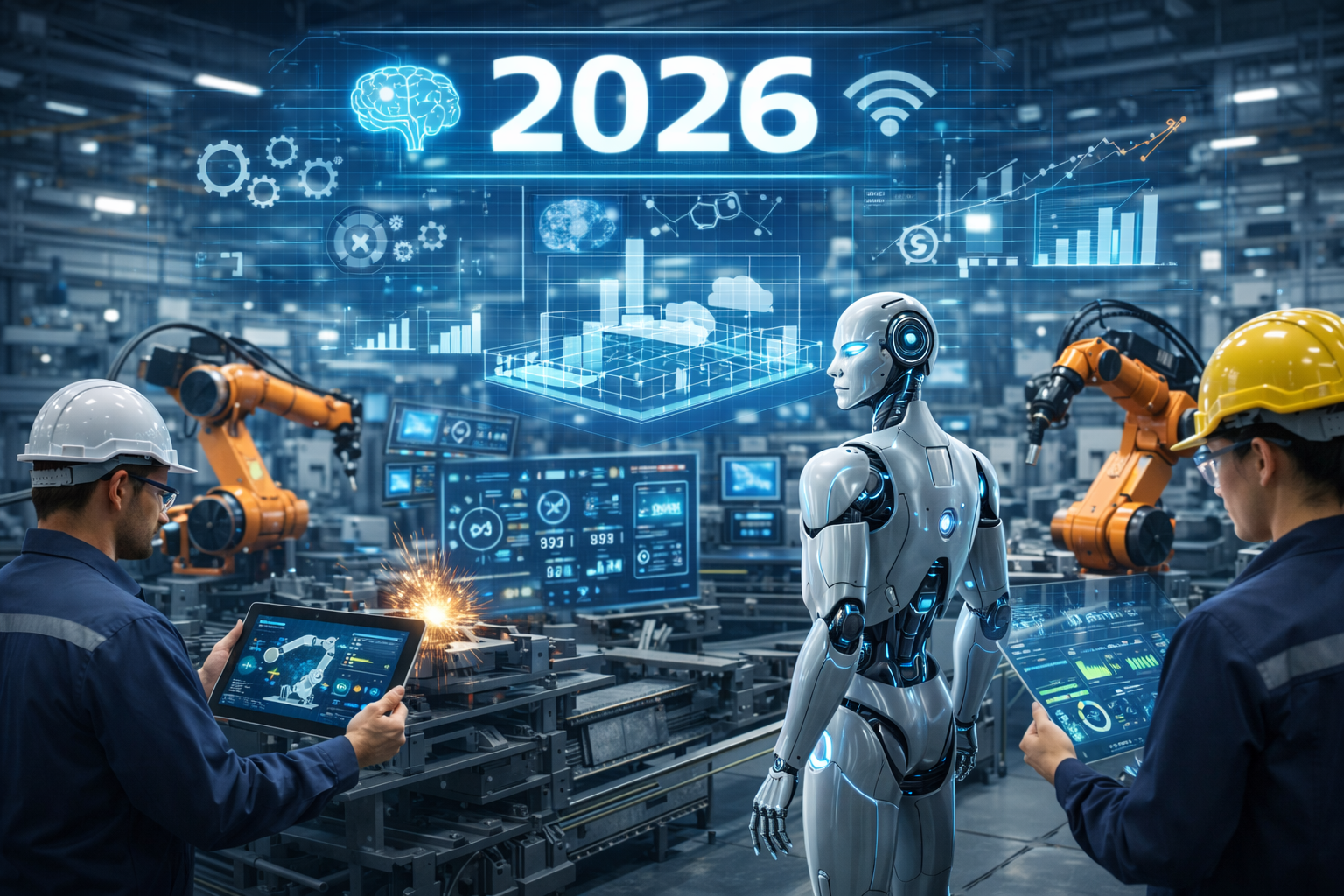
2026: The Year Agentic AI Transforms Industrial Manufacturing

Across global manufacturing, one theme has become increasingly clear: volatility is no longer something companies plan around — it is the environment they operate within. Manufacturers today face a complex combination of challenges: geopolitical uncertainty, ongoing supply-chain disruptions, increasing regulatory pressure, rising customer expectations. Each of these forces affects the entire production cycle — from planning and procurement to execution and delivery. In such conditions, organizations that have built strong digital foundations gain a significant competitive advantage.

Okładka: AI in manufacturing: the real issue isn’t 90% accuracy. It’s data maturity.

AI in manufacturing: the real issue isn’t 90% accuracy. It’s data maturity.

In Industry 4.0 and 5.0 discussions, a common argument appears: AI models reach around 90% accuracy, and in industrial environments a 10% error can cost millions. The reasoning sounds compelling because it is framed numerically and linked to operational risk. However, this argument assumes something critical — the existence of a fully digitized factory. In reality, across many manufacturing plants in Poland and Europe — especially in the SME sector — that level of digital maturity simply does not exist.

Okładka: The Physical AI Revolution: How Networks Power the Age of Intelligent Machines

The Physical AI Revolution: How Networks Power the Age of Intelligent Machines

Picture a warehouse robot navigating the aisles at full speed, or a port crane stacking containers with millimeter-level precision. These aren't machines running pre-written scripts — they're AI systems making decisions in real time. This is what the era of Physical AI looks like. Physical AI refers to intelligent systems capable of sensing, interpreting, and acting in the real world. Autonomous vehicles weaving through city traffic, robotic arms assembling components with surgical accuracy, smart energy grids responding instantly to load changes — these are just a few examples.

Okładka: How MES Systems Feed Digital Twins in NVIDIA Omniverse with Production Data

How MES Systems Feed Digital Twins in NVIDIA Omniverse with Production Data

Digital twins are increasingly appearing in modern factory strategies. Process simulations, virtual production lines, scenario testing without the risk of stopping production – this sounds like the future of manufacturing. One of the most recognizable tools in this area is NVIDIA Omniverse. The problem begins when a digital twin is supposed to stop being a visualization and become a reflection of actual production. For this, data is needed. And this is where MES-class systems play a key role.

Okładka: AI Revolution in Industry: Breakthrough Technologies of January 2026

AI Revolution in Industry: Breakthrough Technologies of January 2026

January 2026 marked a pivotal turning point in the development of artificial intelligence. AI is evolving from an “interactive tool” into a “physical entity” capable of fundamentally transforming all industrial sectors—especially manufacturing. Physical AI and the Robotics Era Jensen Huang, CEO of NVIDIA, announced at CES 2026 that “the ChatGPT moment for robotics has arrived,” signaling a mass transition of AI from the virtual space into the physical world. NVIDIA introduced a series of open models for physical AI, including the Cosmos models capable of understanding the world and generating action plans, as well as Isaac GR00T N1.6, dedicated to humanoid robots. The new Jetson T4000 module, based on the Blackwell architecture, delivers four times higher energy efficiency and AI compute performance compared to the previous generation, priced at USD 1,999 (for orders of 1,000 units). Global companies such as Boston Dynamics, Caterpillar, Franka Robotics, LG Electronics, and NEURA Robotics presented a new generation of robots powered by NVIDIA technologies.

Okładka: Data Sovereignty in Manufacturing: Building Resilient, Secure, and Scalable Industrial Systems

Data Sovereignty in Manufacturing: Building Resilient, Secure, and Scalable Industrial Systems

Why data sovereignty is no longer a technical detail — but a strategic advantage As factories accelerate digital transformation, cloud platforms are often presented as the foundation of innovation. But for manufacturing environments, where every second of downtime translates directly into financial and operational losses, dependency on external cloud services introduces real risk. Data sovereignty — the ability to control where industrial data is processed, who can access it, and how it is governed — is becoming one of the most important pillars of modern manufacturing architecture. This is not a trend. It is the foundation of operational resilience, industrial AI, and competitive advantage.

Okładka: Why Specialized Industries Are the New Frontier of Industrial Innovation

Why Specialized Industries Are the New Frontier of Industrial Innovation

For the last two decades, most digital innovation has focused on mass-market IT: e-commerce, social platforms, and office SaaS. But the largest untapped opportunities now lie in highly specialized, industrial domains — where processes are physical, regulated, and operationally critical. Manufacturing, energy, logistics, and infrastructure do not need more generic software. They need systems that understand how the real world of machines actually works. That is where the next decade of industrial innovation will be built.

Okładka: MES in 2025: Why MES Systems Are No Longer Just "Shop Floor Systems" but the Backbone of Production Data

MES in 2025: Why MES Systems Are No Longer Just "Shop Floor Systems" but the Backbone of Production Data

System MES (Manufacturing Execution System) - If someone in 2025 still thinks of an MES system as "terminals at workstations and reports from the department," it's about as current as a fax machine in OT-IT integration. The Manufacturing Execution System has ceased being a shop floor application. MES has become the operational layer of truth between the world of automation (OT) and the business world (IT). MES systems in 2025 are operational platforms that determine whether a company thrives on availability, quality, lead time, and energy efficiency. The MES system has stopped being a cost—it has become a mechanism for steering competitiveness.

Okładka: Good practices for communication between IT and OT networks. How to build a secure and modern industrial architecture?

Good practices for communication between IT and OT networks. How to build a secure and modern industrial architecture?

Digitalization of manufacturing plants has made automation systems and IT systems work together more closely than ever before. Machine data flows into MES, ERP, and analytical platforms, while IT systems increasingly need access to industrial devices to monitor their status, security, and compliance with corporate policies. This creates tremendous opportunities for business growth, but it also introduces an area that requires exceptional caution. Communication between IT and OT networks is one of the most sensitive points within a facility — it is exactly here where vulnerabilities can emerge, leading to cyberattacks or disruptions in production processes.

Okładka: How does OmniMES support a production manager in improving process efficiency?

How does OmniMES support a production manager in improving process efficiency?

The role of a production manager is becoming more complex every year. Modern factories demand not only smooth operations and on-time execution, but also cost optimization, rapid reaction to deviations, and building a culture of continuous improvement. In such an environment, traditional Excel sheets, manual reports, or intuition-based decisions are no longer enough. This is where OmniMES proves its value — a system that gives the production manager tools to make informed, fast, and accurate decisions.

Okładka: New OmniEnergy Energy Module – Intelligent Energy Management in Compliance with ISO 50001

New OmniEnergy Energy Module – Intelligent Energy Management in Compliance with ISO 50001

As electricity costs continue to rise faster than production margins, companies are increasingly looking for ways to achieve lasting reductions in utility consumption. The answer to these needs is the new energy module in the OmniMES system, which functions as an Energy Management System (EMS). It enables companies to monitor, analyze, and optimize energy consumption across the entire plant — using the same data already utilized by the MES system. This means there’s no need to install sensors or measuring devices twice — the same data can serve both MES and EMS purposes, significantly reducing implementation time and cost.

Okładka: Cloud or On-Premise? How to Choose the Best MES Deployment Model

Cloud or On-Premise? How to Choose the Best MES Deployment Model

Choosing between a cloud-based system and an on-premise solution is one of the most common decisions faced by manufacturing companies considering the implementation of production control systems. Both approaches have their advantages and limitations — they differ in terms of cost, security, deployment speed, and configuration flexibility. This article explains the key differences and shows how the OmniMES system adapts to various business needs, offering both deployment models: OmniCloud (SaaS) and OmniMES On-Premise.

Okładka: 7 Wastes of Muda – How to Understand and Eliminate Waste in Production

7 Wastes of Muda – How to Understand and Eliminate Waste in Production

Every manufacturing company has activities that do not add value to the product yet consume time, resources, and employee energy. In the book Toyota Production System: Beyond Large-Scale Production (1978), Taiichi Ohno identified seven of the most common types of waste. In Lean Manufacturing philosophy, these activities are called Muda – meaning wastefulness or uselessness (Japanese: muda = useless, unnecessary). Japanese companies, led by Toyota, have been effectively eliminating Muda for decades, achieving high production efficiency and flexibility. Understanding the seven classic wastes of Muda helps identify where productivity may be leaking in your company — and how to fix it.

Okładka: Energy Efficiency Directive (EED) – what does it mean for Polish production plants and why it is worth implementing an EMS system

Energy Efficiency Directive (EED) – what does it mean for Polish production plants and why it is worth implementing an EMS system

The revised Energy Efficiency Directive (EED) – Directive (EU) 2023/1791 – sets out the framework and obligations designed to help the European Union achieve ambitious energy-saving targets. Among other things, the EED aims to reduce final energy consumption in the EU by 11.7% by 2030 compared to reference projections. It replaces the previous Directive 2012/27/EU and entered into force on 10 October 2023. Member States are required to transpose its key provisions into national law – the deadline for transposition was 11 October 2025.