
Martin Szerment
AuthorPublished on February 23, 2026
Did you like this article? Share it!
In Industry 4.0 and 5.0 discussions, a common argument appears: AI models reach around 90% accuracy, and in industrial environments a 10% error can cost millions. The reasoning sounds compelling because it is framed numerically and linked to operational risk.
However, this argument assumes something critical — the existence of a fully digitized factory.
In reality, across many manufacturing plants in Poland and Europe — especially in the SME sector — that level of digital maturity simply does not exist.

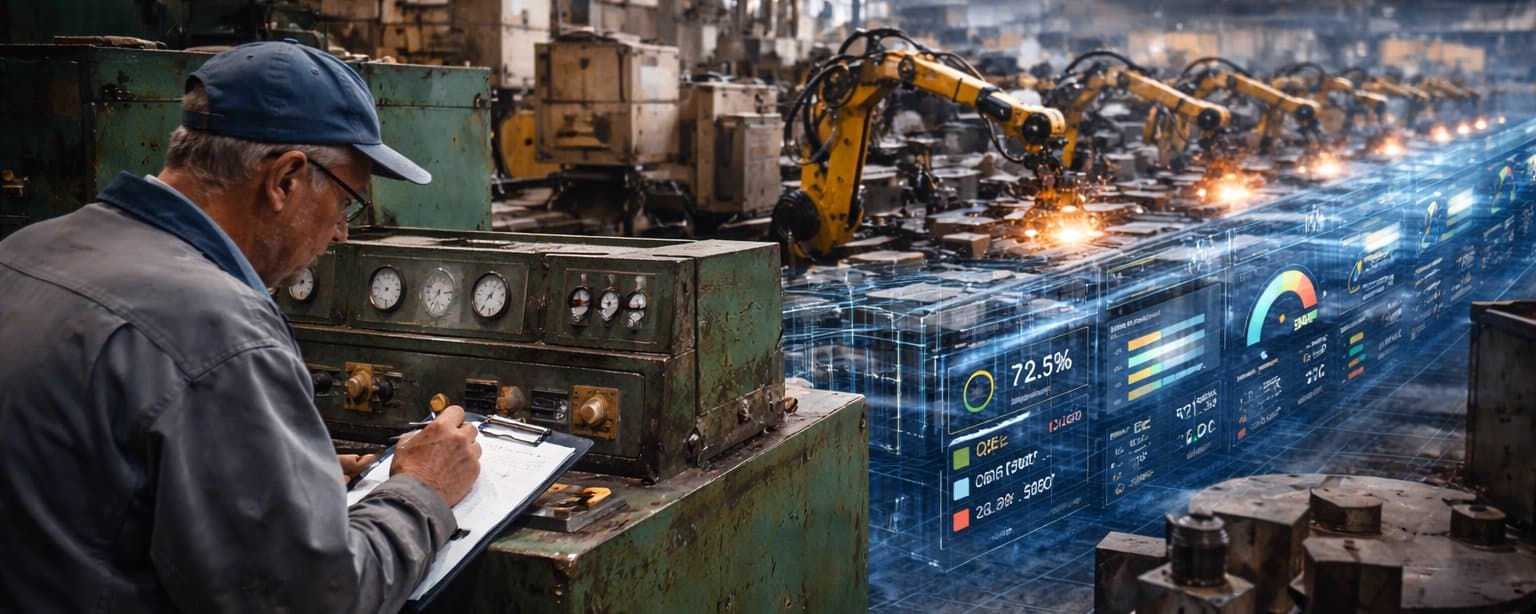
Many factories operate in what could be described as “analog production with a digital front-end.” ERP systems are present. Production planning tools are implemented. Sometimes even BI dashboards exist. But on the shop floor:
-
machines are not connected to central systems,
-
downtime data is recorded manually,
-
OEE is calculated in spreadsheets,
-
there is no structured event history,
-
departments operate in isolated data silos.
In such an environment, asking whether AI achieves 90% or 95% accuracy becomes secondary. AI cannot function effectively without structured, continuous, high-quality data.
MES as infrastructure, not optional software
A Manufacturing Execution System is not just another IT deployment. It is the infrastructure layer that enables:
-
real-time production and energy measurement,
-
automatic KPI calculation (OEE, MTBF, MTTR),
-
systematic downtime classification and loss analysis,
-
contextual event reconstruction (signal sequences, alarms, parameter shifts).
Only with this foundation does a machine failure become more than an isolated incident — it becomes a recognizable pattern.
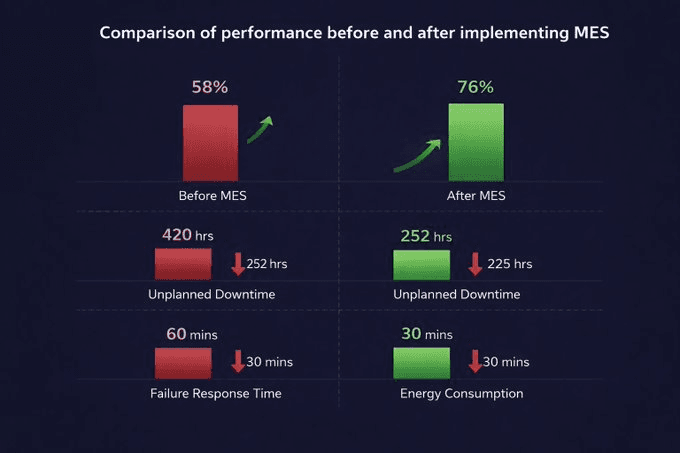
Importantly, measurement and visualization alone deliver significant results — even before AI is introduced:
-
20–40% reduction in unplanned downtime,
-
10–25 percentage point increase in OEE,
-
30–60% faster response to failures,
-
10–20% lower energy consumption.
These are gains driven by transparency and structured data — not predictive algorithms.
The main barriers are organizational, not technological
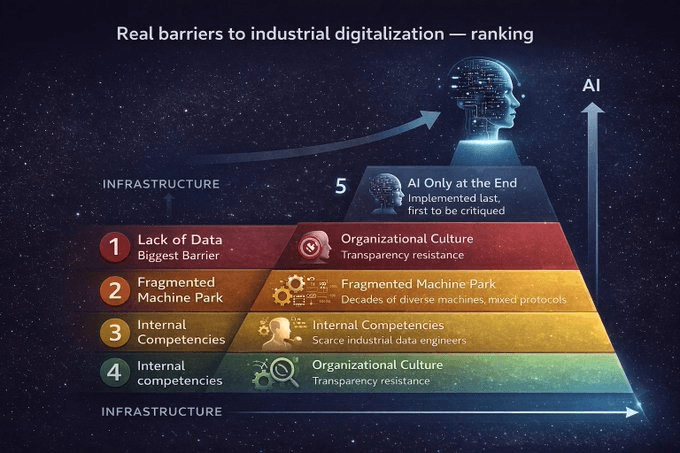
Implementation experience consistently shows that transformation challenges are primarily structural:
-
Lack of continuous data collection.
-
Heterogeneous machine environments and integration complexity.
-
Shortage of cross-functional industrial data expertise.
-
Cultural resistance to operational transparency.
-
Only at the final stage — AI.
Predictive models and autonomous optimization systems come last — not because they are less valuable, but because they depend on everything that precedes them.
Reframing the question
The debate should not start with:
“Is AI accurate enough?”
It should start with:
“Do we have reliable, real-time data describing what is happening on our shop floor?”
If the answer is no, the first investment is measurement infrastructure and MES.
If the answer is yes, then analytics and AI can deliver meaningful and scalable value.
Full article available here:
AI in manufacturing: the real issue isn’t 90% accuracy. It’s data maturity.